I love it when my kids pleasantly surprise me; (the other type of surprise, like doing a number two with no nappy on, I can do without). Pleasant surprises, like the day I heard my kids singing their ABC’s all by themselves, that brought a smile to my face. More recently, Mr N and M pleasantly surprised me with their curiousity about letters; reading letters and writing letters.


How to Teach Reading and Writing Letters: Four Guidelines

 
There are many possible ways to introduce reading and writing letters to young children. Here are four guidelines I have found helpful when deciding the order in which to teach letters to young children.

 
{ONE} Start with the most common sound for a new letter. This is usually the sound the letter makes in a short word, e.g. fat, bet, sit, etc

 
{TWO} Separate visually or auditorily similar letters. Separating similar letters reduces the possibility of confusion. These sounds are similar: f and v; t and d; b and d; b and p; k and g; m and n; i and e; o and u. These letters are visually similar: b and d; b and p, q and p, n and m; h and n; v and w; n and r.

 
{THREE} Introduce more useful letters first. Learning more useful letters helps children decode more words. Vowels are the most useful letters. More useful consonants are b, c, d, f, g, h, k, l, m, n, p, r, s, and t.

 
(FOUR} Introduce lower-case letters first. Since a majority of words when writing and also in reading are lower-case letters, lower-case letters should be taught before uppercase letters.


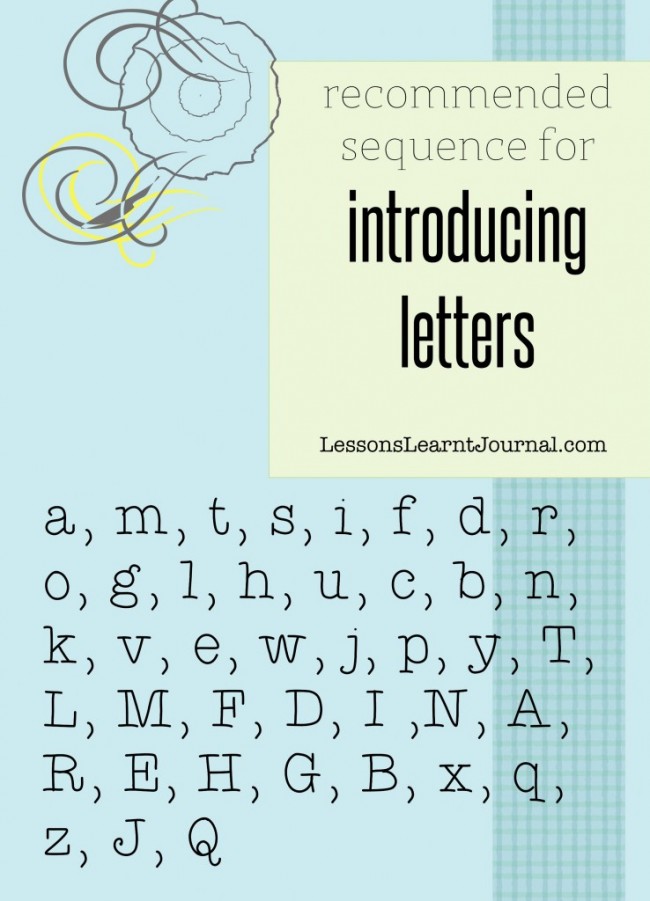
A recommended sequence for introducing reading and writing letters to young children

 
Here is one possible order I’ve used to teach letters to young children.


Be sure to subscribe to LessonsLearntJournal.com so you don’t miss our Write and Play Series, Rainbow Writing Series, Reading Games Series and Math Games Series in the coming weeks.

 
Check out our Handwriting free printables series, starting with our Handwriting Free Printable: Rainbow Writing {a}

 
Don’t miss our first Reading Game: Mr Tongue’s House; a fun reading game for developing phonemic awareness. These skills lay the groundwork for later reading skills, e.g. sounding out words and blending.

 
Lessons Learnt Journal


January 2013
N&M: 4 years, 8 months


If you enjoyed this post, please consider leaving a comment; I’d love to hear from you.
If you are new here, you might like to subscribe to our RSS feed or receive updates direct to your email. We have many fun ideas to share.
 

About the author

Pauline Pauline LessonsLearntJournal is all about life with kids. On Lessons Learnt Journal you'll find activities for children: play, maths games, handwriting, reading as well as parenting confessions. Pauline is a Christian, Wife, Mother of 4, Primary School Teacher. When not blogging, she may be found virtually hoarding on Pinterest, trying to decide which Instagram filter to apply, or compulsively refreshing her Facebook feed. Most days you'll find her chasing her kids and that much needed nap.

Tagged with →  
Share →

8 Responses to How to Teach Reading & Writing: Letters

  1. Jode says:

    Thanks for this post Pauline…i took away a lot from this…looking forward to more in your series!

  2. Looks like we were thinking about the same topic this week. I talked about letter identification with my 2 year-old this week on my blog. I really like your sequence of introduction and stressing start with lowercase letters. Couldn\’t agree more especially when introducing sounds for beginning readers. Thanks for sharing!

  3. Louise says:

    I feel like I’ve started this late with my daughter…but better late than never. Thanks again Louise x

  4. Catelin says:

    Hello Pauline,
    The second picture provided of letter sequence doesn’t have each letter twice and is there a method to the order? Forgive my ignorance please, I’m just looking to learn.

    • Pauline says:

      Hi Catelin,

      Welcome! So glad to have you here. You’ve asked a great question :) . I haven’t repeated some letters in this introductory sequence, to include both upper and lower case, because some letters are visually alike in both lower and uppercase forms, e.g. s and S.

      xo P

Leave a Reply

Your email address will not be published. Required fields are marked *

You may use these HTML tags and attributes: <a href="" title=""> <abbr title=""> <acronym title=""> <b> <blockquote cite=""> <cite> <code> <del datetime=""> <em> <i> <q cite=""> <strike> <strong>