Navigation Menu+

Baby: Motor Skills

Posted on Jul 30, 2012 | 17 comments


Baby Motor Skills

 
I once caught a snippet of a documentary presenting the remarkable fact that healthy babies of all cultures achieve the same milestones in the same consistent sequence at roughly about the same time. Baby motor skills progress in a consistent manner, regardless of culture.

 
Having had four babies within the tiny space of three and a half years, this remarkable fact about baby motor skills still astounds me.

 
There are variances, of course,  in a baby’s rate of motor development. My twins were walking at about nine months and ever so eager to bounce, flip and spin. My daughter Miss K on the other hand is almost nine months old and enjoys exploring our living room by rolling from one corner to another.

 
Regardless of the rate at which my kids developed their gross and fine motor skills, they all enjoyed those precious months of early baby play. They all went through a phase when box play was all the craze; and as long as there was a ball around, there was always a baby ball game to play, no matter what stage of development they were at.


Baby Motor Skills Milestones

 
There are two types of baby motor skills: gross and fine.

 
Gross motor skills involve the coordination of the large muscles groups; trunks and limbs. They help us move from place to place.

 
Fine motor skills involve the smaller muscles of the arms and hand and help us manipulate our surroundings.
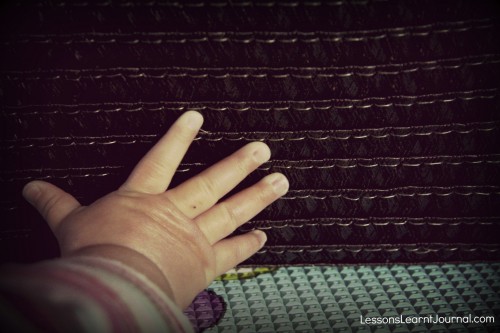


Baby Gross Motor Skills and their typical month of onset*

  • Holds head up and steady (1-2)
  • Lifts head and chest whilst on tummy (2-3)
  • Sits whilst supported (2-3)
  • Rolls tummy to back (3-4)
  • Rolls back to tummy (3-4)
  • Sits alone (6-8)
  • Pulls to stand (8-9)
  • Crawls (9)
  • Cruise walking (9-10)
  • Stands alone (11-12)
  • Walks alone (12-13)

 
Baby Fine Motor Skills and their typical month of onset*

  • Reflexive grasp (birth)
  • Ineffective pre-reaching (1-3)
  • Voluntary grasp (3)
  • Successful reach and grasp (4-5)
  • Controlled reach and grasp (6-7)
  • Pincer grasp with thumb and forefinger (9)
  • Claps hands (10)
  • Releases objects crudely (12-14)
  • Controlled release (18)

 
* Source: What’s Going on In There? By L. Eliot (2000)

 
As with anything, there is a range in what is considered normal for baby motor skills. Roughly, what is deemed normal is reaching between two and seven months; sitting alone between five and nine months and walking well between nine and fifteen months.



Supporting a Baby’s Motor Development

 
L. Eliot (2000) makes the interesting point that practise is essential for baby motor skill development, provided it’s done at the right time, i.e. when a baby is ready for it.

 
If done too early, you could end up training the wrong neural pathways or simply frustrate and discourage the baby. However, when ready, baby motor skill practise is required to refine skilled movement.

 
As Miss K. enjoys rolling around and grasping at things, I am reminded to provide her with a safe, unrestricted environment for exploration so she can practise and refine her baby motor skills.

 
It would also be good to remember the importance of sensory feedback, and the important role her sense of balance and motion plays in her development.

 
Baby proofing our home seems to be a never ending process; but they do seem to grow ever so quickly.

 
Lessons Learnt Journal


K: 8 months
July 2012


If you enjoyed this post, please consider leaving a comment; I’d love to hear from you.
If you are new here, you might like to subscribe to our RSS feed or receive updates direct to your email. We have many fun ideas to share.
About the author

Pauline Pauline LessonsLearntJournal; because #playmatters. On Lessons Learnt Journal you'll find activities for children, play, parenting, maths games, handwriting, reading and much more. Pauline is a Christian, Wife, Mother of 4, Primary School Teacher. When not blogging, she may be found virtually hoarding on Pinterest, trying to decide which Instagram filter to apply, or compulsively refreshing her Facebook feed. Most days you'll find her chasing her kids and that much needed nap.

Share on Facebook

17 Comments

  1. Aren’t babies fascinating! Watching them achieve little milestones and how happy they are as they do is pretty special stuff :-)

    • Pauline

      I agree Kelly. It boggles my mind how quickly they learn and grow. They are so very resilient! It is such a privilege to observe and be part of.

  2. Very informative Pauline. My little munchkins (twins) have surpassed their milestones thankfully. I’m going to miss cheering them on for the little things though.

    • Pauline

      Thanks Penny for visiting. I have twin munchkins too. Very cheeky and energetic ones at that. Happy birthday to your blog! Will be sharing the news about your fab giveaway with my FB readers soon. Xoxo Pauline

  3. Such a well researched and informative post Pauline. There’s nothing more wonderful than watching your child as they struggle with and then finally master all of these milestones.

    • Pauline

      Thanks Ness. It is such a privilege to watch them grow isn’t it. Hope you’re well. xoxo P

    • Pauline

      Thanks Deb for the pin. Hope you’re doing well this lovely Friday. xoxo P

  4. I still find it amazing how different every child is The Fairy didn’t walk till 18months (but was sooo communicative even before a year). The Frog (at 10months) is practically walking alone.

    • Pauline

      Variety is the spice of life! I love the nicknames you’ve used for your kiddos. Very cute. xoxo P

    • LOVE your nicknames! So fun and clever.

  5. What a great post! This is a wonderful resource ~ especially since we’ll be adding to our family, soon! Thanks for sharing!

    • Pauline

      How exciting Gina! Look forward to hearing more as it happens :) xoxo P

  6. This is such a handy dandy little resource. My kiddo was way off on these though (as you said, there are variances). I had a hands free walker at 7 mo. & 3 wks. She didn’t skip any steps, she just did everything super early. She’ll be 2 in October and she has recently taken to potty training herself. Its cool right now, but with all this early independence I anticipate an *interesting* teenager. Eek!

    • Pauline

      Woah – hands free walker at 7 mo & 3 wks! That’s amazing, AK. You never know about the teenage years. She may well take you by surprise.. :) .

  7. This article got my attention as I am working on motor skill with my 11 week old new nmorn. She was incredinly pre mature, she is a x-micro preemie and was born at 23 wekks. Now that she is 11 weeks corrective I try my best to practice – but not over due it. I am curious, when you say “done too early” is that directed to doing what is expected before the estimated time period? For example trying to teach her to crawl would be way too early however, teaching her to grab and hold her toys is the estimated milestone for her age? Just curious :) thank you in advance

    • Pauline

      Hi Sarah,

      Premmie babies have a very special place in my heart. (3 of my 4 were born premature). What an absolute trouper your daughter is; x preemie at 23 weeks!).

      Brains have their own fixed schedule for laying down basic motor pathways. The pace at which those motor pathways mature place limits on when various motor skills emerge. If the right neural circuits are wired up ready, that together with so many factors; (the pace of their sensory development, physical growth, strength, nutrition, motivation, emotional well-being, daily practice) plays a part in a child’s motor skill development.

      With premature babies, it is so hard to know when a typical milestone would apply, even with the use of a corrected age. With premature babies, it’s best to speak to a Paediatrician who specialises in growth and development. Even with my now four year old twins, I still find that there are certain things we need to look out for because of their premature birth.

      I hope this helps.

      xoxo P

Submit a Comment

Your email address will not be published. Required fields are marked *

You may use these HTML tags and attributes: <a href="" title=""> <abbr title=""> <acronym title=""> <b> <blockquote cite=""> <cite> <code> <del datetime=""> <em> <i> <q cite=""> <strike> <strong>